Flower Watering Can: A Designer’s Review for Business Merch
As an embroidery designer who has spent years digitizing patterns and consulting with small business owners, I look at every new machine embroidery design through a specific lens. It is not just about whether the image is pretty; it is about whether it functions as a viable asset for commercial embroidery projects. Today, I am reviewing Flower Watering Can, a charming piece that sits squarely in the Floral category. This review is tailored for apparel decorators, Etsy sellers, boutique owners, and anyone looking to elevate their small business merch with high-quality Embroidery.
First Impressions: Visual Personality and Brand Fit
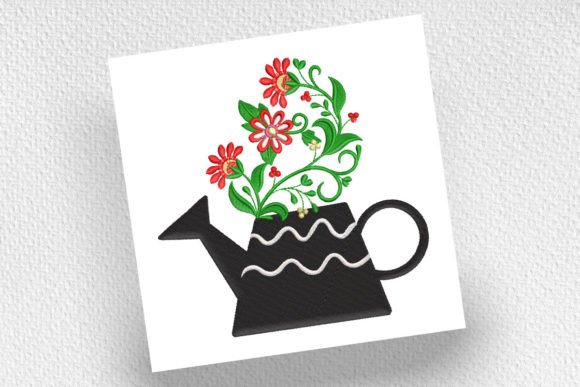
The first thing that strikes me about Flower Watering Can is its inherent warmth. The combination of a watering can and blooming flowers creates an immediate association with growth, care, and nurturing. Visually, this design feels friendly, rustic, and handmade. It does not scream corporate rigidity; instead, it whispers approachability. For brands in the lifestyle, home goods, or wellness sectors, this visual personality is gold. It suggests a brand that values tradition and natural beauty.
However, "lovely" can sometimes be mistaken for "generic." To make this work for a serious business, we must look at how it translates from a digital concept to a tangible finished product. The description notes it is suitable for t-shirts, clothing, bags, caps, and pillowcases. This versatility is promising, but it requires strategic placement. A design that tries to be everything to everyone often ends up being nothing to anyone. Therefore, my advice is to treat Flower Watering Can as a signature accent rather than a dominant logo, unless your brand identity is explicitly centered around gardening or floristry.
Real-World Applications for Small Businesses
Let us move beyond theory and discuss where this embroidery file can drive real value. Imagine you run a local bakery or a boutique café. Your staff uniforms are a walking billboard. Placing Flower Watering Can on the chest pocket of an apron or the sleeve of a work shirt adds a layer of curated detail that customers notice. It transforms a standard uniform into custom apparel that reflects the shop’s aesthetic.
- Branded Patches: This design is ideal for creating an embroidered patch. Patches are versatile; they can be ironed onto denim jackets, tote bags, or even used as hang tags for your products. A patch allows you to control the background fabric color, ensuring the thread colors pop regardless of the garment it is applied to later.
- Tote Bag Design: Canvas tote bags are a staple for retail businesses. Embroidering this floral motif on a neutral canvas bag creates a premium feel that printed ink simply cannot match. The texture of the stitches adds perceived value, encouraging customers to reuse the bag, which extends your brand exposure.
- Cap Embroidery: For a subtler approach, consider placing a scaled-down version on the side panel of a baseball cap. Front-center placement might be too busy depending on the complexity, but a side detail acts as a sophisticated Easter egg for loyal customers.
- Product Packaging Accents: If you sell handmade soaps, candles, or ceramics, a small embroidered label featuring this design can serve as a luxurious seal of quality. It turns simple packaging into a memorable unboxing experience.
Technical Considerations and Production Challenges
While the aesthetic appeal is strong, a professional designer must address the technical realities of stitching. The description mentions it can be stitched on various items, but we must exercise caution with stitch density and scale. If you plan to use this on a small area, such as a hat front or a tiny pocket, you must ensure the details do not become muddy. High stitch density on small curves can cause puckering, especially on lighter fabrics.
Fabric texture plays a crucial role here. On a thick towel or a structured backpack, the design will hold its shape well. However, on a thin, stretchy t-shirt, you must use the correct stabilizer to prevent distortion. I always recommend testing the design on a scrap piece of the exact fabric you intend to use for production. Do not assume it will work perfectly on every material listed in the description without verification.
Another critical factor is color contrast. The watering can and flowers likely require multiple thread colors to distinguish the elements. If you are stitching on dark uniforms, you may need to add an underlay or choose brighter thread shades to ensure the design does not get lost in the shadows. Conversely, on white fabric, ensure the outlines are distinct enough to define the shape clearly.
Impact on Brand Identity and Customer Trust
Why go through the trouble of embroidery when printing is cheaper? The answer lies in brand identity and perceived value. Embroidery signals permanence and quality. When a customer sees Flower Watering Can stitched onto a product, they subconsciously associate your brand with durability and attention to detail. This builds trust. In a market saturated with fast fashion and disposable goods, a well-executed embroidered item stands out as a heirloom-quality piece.
Furthermore, consistency is key. If you use this design across your design assets—from your website’s printable mockup to the actual physical product—you create a cohesive visual language. This consistency helps with brand recognition. Customers begin to associate that specific floral watering can motif with your business, fostering a sense of familiarity and loyalty.
Practical Designer Notes for Implementation
Before you purchase the digital embroidery file and start mass production, follow these steps to ensure success:
- Check the Specs: The provided description does not list the exact hoop size, stitch count, or file formats. You must verify these details with the seller. Ensure the file format is compatible with your machine (e.g., PES, DST, JEF).
- Test in Monochrome: Before committing to multi-color threads, stitch the design in black and white. This helps you evaluate the clarity of the lines and the balance of positive and negative space without the distraction of color.
- Review Licensing: Confirm the commercial licensing terms. Just because you bought the file does not automatically mean you can sell thousands of units. Ensure the license covers your intended volume of small business merch sales.
- Create Mockups: Use a printable mockup or digital rendering to show clients or stakeholders how the design looks on different items. This helps manage expectations and secure approval before stitching begins.
- Inspect Spacing: Look closely at the spacing between the watering can spout and the flowers. If elements are too close, they may merge during stitching. Minor edits in your embroidery software might be necessary to optimize the design for your specific machine.
In conclusion, Flower Watering Can is a versatile and emotionally resonant design that, when used correctly, can significantly enhance your product offerings. It is not just a decoration; it is a tool for storytelling. By paying attention to technical details like stabilizer choice, thread contrast, and placement, you can transform this lovely floral motif into a powerful element of your brand’s visual identity. Whether you are outfitting staff, creating gifts, or launching a new line of tote bags, this design offers the charm and professionalism that modern consumers crave. Just remember to test, verify, and stitch with intention.